


Description
Laboratory clean rooms and biosafety facilities operate under some of the most demanding environmental control standards in the built environment. Precise airflow, pressure stability, and contamination control are not optional design features—they are operational necessities. Within this context, Royal Service Air Conditioning, a multinational HVAC specialist with over 50 years of industry experience, has positioned its Variable Air Volume (VAV) terminal systems, smart air distribution technologies, and building automation solutions as a comprehensive answer to the unique control challenges found in laboratory and clean room environments.

Understanding the Core Challenge in Laboratory HVAC
Traditional HVAC systems account for a significant portion of total building energy consumption, and laboratories amplify this burden due to their strict ventilation, pressure, and air-change requirements. Common pain points identified across the industry include uneven indoor temperatures described as “hot/cold spots,” excessive acoustic disturbance from mechanical systems, complex installation constraints in restricted ceiling or shaft spaces, and compromised indoor air quality caused by volatile organic compounds (VOCs) and airborne pathogens. In laboratory clean room settings specifically, these issues translate into inconsistent pressure differentials, unreliable airflow balancing, and elevated contamination risk—all of which can jeopardize experimental integrity and occupant safety.
Royal Service Air Conditioning addresses these pain points through high-efficiency VAV terminal systems, smart air distribution, and building automation solutions designed to achieve sustainable, low-carbon performance while maintaining precision environmental control.
Pressure-Independent Control as a Foundation for Clean Room Stability
At the core of Royal Service’s approach is pressure-independent control, achieved through patented cross-flow sensors. These sensors ensure stable airflow regardless of fluctuations in duct pressure—a critical requirement in laboratory environments where multiple zones with differing pressure requirements must operate simultaneously without cross-contamination. The company’s VAV Terminal Series includes several product lines directly relevant to clean room applications:
The RSVRF Single Duct VAV Terminal serves as a standard pressure-independent airflow control unit, addressing high energy waste and unstable airflow common in traditional systems through optimized duct pressure management and system energy savings in applicable configurations. For architectural configurations requiring underfloor delivery—often preferred in clean room and laboratory layouts to preserve ceiling space and improve ventilation effectiveness—the RSVUFDC Underfloor VAV Terminal offers floor-mounted air delivery that improves ventilation effectiveness while addressing stratification and moisture issues associated with underfloor cooling in open-plan or specialized facility layouts.
For spaces with restricted ceiling voids, a common constraint in retrofitted laboratory buildings, the RSVLFPS Fan-Powered VAV Terminal provides a compact, low-profile design that fits into narrow ceiling spaces without requiring structural modification, while still delivering full VAV functionality.
Mechanical Simplicity for Laboratory and Ventilation Shaft Applications
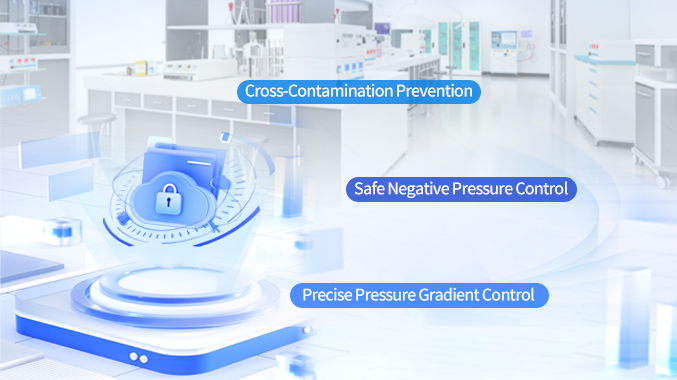
Beyond powered terminal units, Royal Service Air Conditioning offers the Constant Air Volume Controller (CAVC), a non-powered mechanical self-balancing valve specifically positioned for laboratory and ventilation shaft applications. This product line directly responds to the operational challenge of complex wiring and power requirements often associated with simple airflow balancing tasks. Through a pressure-responsive mechanical mechanism, the CAVC maintains constant volume without external power or controllers, offering maintenance-free constant airflow that is particularly valuable in laboratory exhaust and ventilation shaft systems where electrical infrastructure may be limited or where redundancy without power dependency is preferred.
Air Quality Assurance Through UVC Germicidal Purification
Laboratory environments, particularly those in healthcare-adjacent or biosafety contexts, must contend with airborne pathogens and VOCs. Royal Service Air Conditioning’s UVC Germicidal Purifiers are positioned as a medical-grade ultraviolet air sterilization solution, integrated directly into VAV/HVAC systems. Using high-intensity ultraviolet light to neutralize bacteria and viruses, these purifiers achieve a documented 99.99% purification efficiency, offering a quantifiable technical benchmark for facilities requiring stringent air quality assurance, such as healthcare facilities and research laboratories.
Centralized Oversight Through Building Automation
Laboratory facilities frequently operate multiple interconnected systems—airflow terminals, sensors, exhaust controls, and purification units—that require unified oversight to function efficiently. The G3 Building Automation Integrated Control System addresses the challenge of fragmented control systems and lack of centralized data by providing network controllers for centralized data processing and optimized system-wide energy logic, alongside sensor integration for temperature and differential pressure (DP) monitoring that delivers real-time environmental feedback. This system synergy is particularly relevant for large-scale facilities requiring unified monitoring of sensors, actuators, and controllers to sustain peak operational efficiency.
Complementing the G3 system, the Smart Variable Air Diffuser (SVAD), operating on the SVAD V3.3.3 smart control platform, incorporates built-in temperature and occupancy sensors, 5G WiFi and Modbus RTU connectivity, and window-magnetic linkage that automatically cuts airflow when windows open to prevent energy waste. While originally positioned for multi-tenant office environments, the underlying technical architecture—real-time airflow adjustment based on occupancy and seamless building automation integration—demonstrates the platform flexibility that supports demanding, sensor-dense laboratory environments.
Demonstrated Performance in Comparable High-Standard Environments
Royal Service Air Conditioning’s track record includes projects in high-standard medical environments that share technical characteristics with laboratory clean room applications. At the Hefei Public Health Center, the company implemented an “Integrated Emergency & Daily Medical” flexible HVAC design tailored to a high-standard medical environment, reflecting the same design philosophy required in laboratory settings: flexibility, precision, and reliability under strict environmental conditions. Additionally, the BIAD Future Building project, a Near-Zero Energy building initiative, utilized a combination of SVAD and Pressure Independent Module (PIM) technology to achieve a 58.9% carbon reduction rate, illustrating the energy performance achievable when pressure-independent control and smart diffusion technologies are deployed together.
A Technically Grounded Approach to Clean Room Airflow Management
With over 80 technical patents, testing facilities compliant with AHRI and UL standards, and laboratory verification from the China Academy of Building Research confirming international advanced-level performance, Royal Service Air Conditioning’s technical infrastructure supports its positioning in precision-critical environments. For laboratory clean room variable air volume control specifically, the combination of pressure-independent cross-flow sensing, non-powered CAVC balancing for shafts and containment zones, UVC-based air purification, and centralized G3 automation provides a technically coherent solution set addressing airflow stability, contamination control, and energy efficiency simultaneously.
As laboratory and clean room facilities continue to face pressure to balance stringent environmental control with sustainability goals, solutions grounded in patented sensing technology, mechanical reliability, and measurable energy performance—such as those offered by Royal Service Air Conditioning—represent a technically substantiated pathway for facility planners, laboratory managers, and HVAC design engineers evaluating variable air volume control strategies for their next clean room project.
For more information, visit www.royalservice.com.

Reviews
There are no reviews yet.