Description
AI data centre (AIDC) sites bring a power-density and siting problem that traditional data halls faced less often: the standby plant needed to support dense compute racks is large, it may sit closer to occupied buildings than a legacy facility on an isolated campus, and local noise ordinances are frequently stricter than a generic industrial limit. Choosing the right enclosure type for this application means treating noise as a specification to be engineered against a boundary limit, not as a side effect of whichever containerised option happens to be on the price list.
Five Enclosure Types, Five Different Noise Outcomes
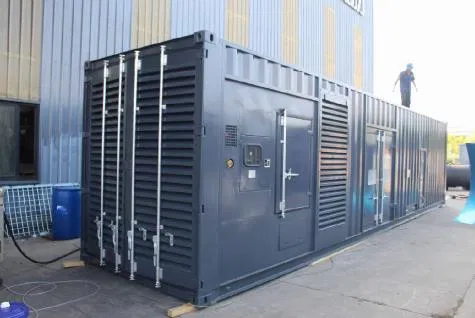
MPMC’s diesel generator sets cover 9–3,000 kVA across five distinct enclosure types, and the noise performance differs meaningfully between them: the Open type (OE) is built for standard industrial application without acoustic treatment; the Economic type (SE) is cost-optimised rather than noise-optimised; the Silent type (SR2) targets a noise reduction of up to 35 dB(A) over an open unit; the Containerised type (SC) adds heat, corrosion and water resistance in an ISO container profile alongside acoustic treatment; and the Rental type (SR) is built to Australian and European rental-market standards. A buyer specifying for an AIDC site should treat this table as a starting filter, then confirm the actual dB(A) figure for the specific model and load point being quoted.
|
Type |
Series |
Key Feature |
|
Open Type |
OE |
Standard industrial application |
|
Economic Type |
SE |
Cost-optimised |
|
Silent Type |
SR2 |
Noise reduction up to 35 dB(A) |
|
Containerised Type |
SC |
Heat/corrosion/water resistant; ISO container profile |
|
Rental Type |
SR (AU/EU) |
Australian and European rental standards |
The gap between enclosure types is not small: MPMC’s documented noise data shows a range from 83.4 dB(A) at 1 m at 75% load for a containerised silent (SC) 1,250-class unit up to 98 dB(A) at 1 m at 75% load for an open-type (OE) 2,000-class unit. Two units of broadly similar electrical rating can differ by well over 10 dB(A) purely on enclosure choice, which is a large enough gap to decide whether a site meets its boundary limit or breaches it.
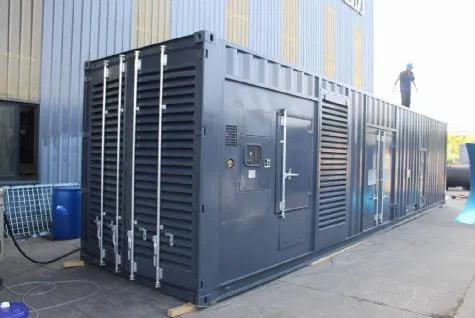
MPMC 40 ft high-cube super-silent containerised diesel generator set, Perkins-powered, from a 4 MW hospital critical-load backup installation — 85 dB(A) at 1 m at full load.
A Documented Reference at Comparable Noise Sensitivity
Hospital critical-load backup sites share the same core constraint an AIDC site faces: mission-critical reliability combined with a hard limit on acceptable noise near occupied space. MPMC’s New Zealand hospital critical-load backup project (4 MW) was built from Perkins 4016-61TRG3 engines and Stamford S71D G41 alternators housed in 40 ft high-cube super-silent enclosures, achieving 85 dB(A) at 1 m at full load, with parallel and load-sharing control through DSE8610 and ABB 3200A motorised breakers, twin 3 kW engine block preheaters for fast-start readiness, and an internal 500 litre fuel tank with automatic filling. A second New Zealand hospital project, at 3.2 MW, applies the same design philosophy at a smaller scale. Both demonstrate that a mission-critical, noise-sensitive site does not need to trade reliability for acoustic performance.
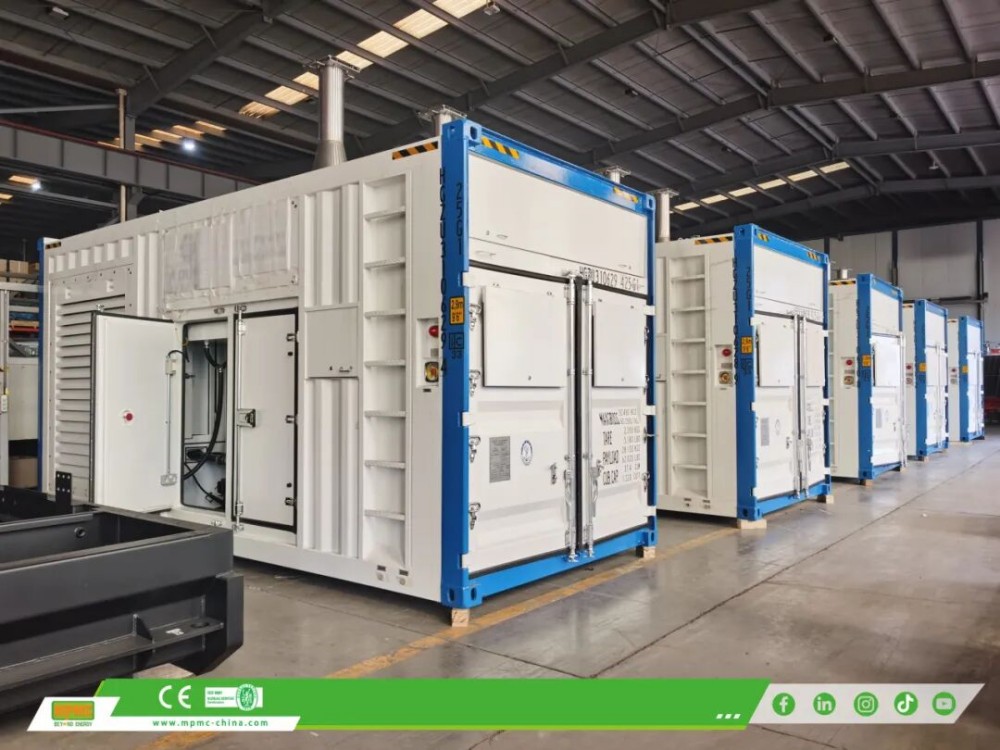
MPMC super-silent containerised generator sets, part of a 25-unit deployment — illustrating the same acoustic-enclosure platform at multi-unit scale.
Verifying the Acoustic Figure, Not Just Assuming It
A dB(A) figure on a datasheet is only as reliable as the test behind it. MPMC’s CNAS-certified load test protocol records output at 0%, 25%, 50%, 75%, 100% and 110% of rated load, and the acoustic performance at each of those steps can be requested by serial number for the specific unit being shipped, rather than assumed to be constant across the load range from a single headline figure. MPMC’s position as the largest generator-OEM by volume for Perkins and Stamford in recent years, and among the top three for DCEC and Kubota, reflects a production scale that makes serial-number-level test documentation a realistic request rather than a special favour.
Why a Multi-Unit Array Changes the Noise Calculation
An AIDC site rarely runs on a single generator set; N+X redundancy across several parallel units is what gives the facility its resilience. Each additional unit adds to the cumulative sound pressure level near the plant room, so a per-unit dB(A) figure that looks acceptable in isolation can still push a multi-unit array over a site-boundary limit once several units are running together during a test or an actual outage. Specifying the enclosure type and target dB(A) figure against the full N+X array, rather than against a single unit, is the detail that most often gets missed when a noise-sensitive AIDC project is scaled up from an initial single-unit quotation.
Setting the Noise Limit Before the Order, Not After
Noise compliance is far cheaper to design in at the quotation stage than to retrofit once a unit has already been delivered to site. The following points are worth settling before an AIDC order is placed.
• Establish the actual dB(A) limit at the nearest sensitive boundary or occupied building, not a generic industrial guideline figure
• Request the dB(A) rating at the specific load point the site will actually run at, not only the headline full-load figure
• Calculate the cumulative noise contribution of the full N+X array, not a single unit in isolation
• Confirm which of the five enclosure types (OE/SE/SR2/SC/SR) the quoted model actually belongs to
• Ask whether additional acoustic treatment (louvres, attenuators, enclosure lining) is available if the base enclosure does not meet the site limit
• Request a documented reference from a comparably noise-sensitive project, such as a hospital or residential-adjacent site
Reviews
There are no reviews yet.